
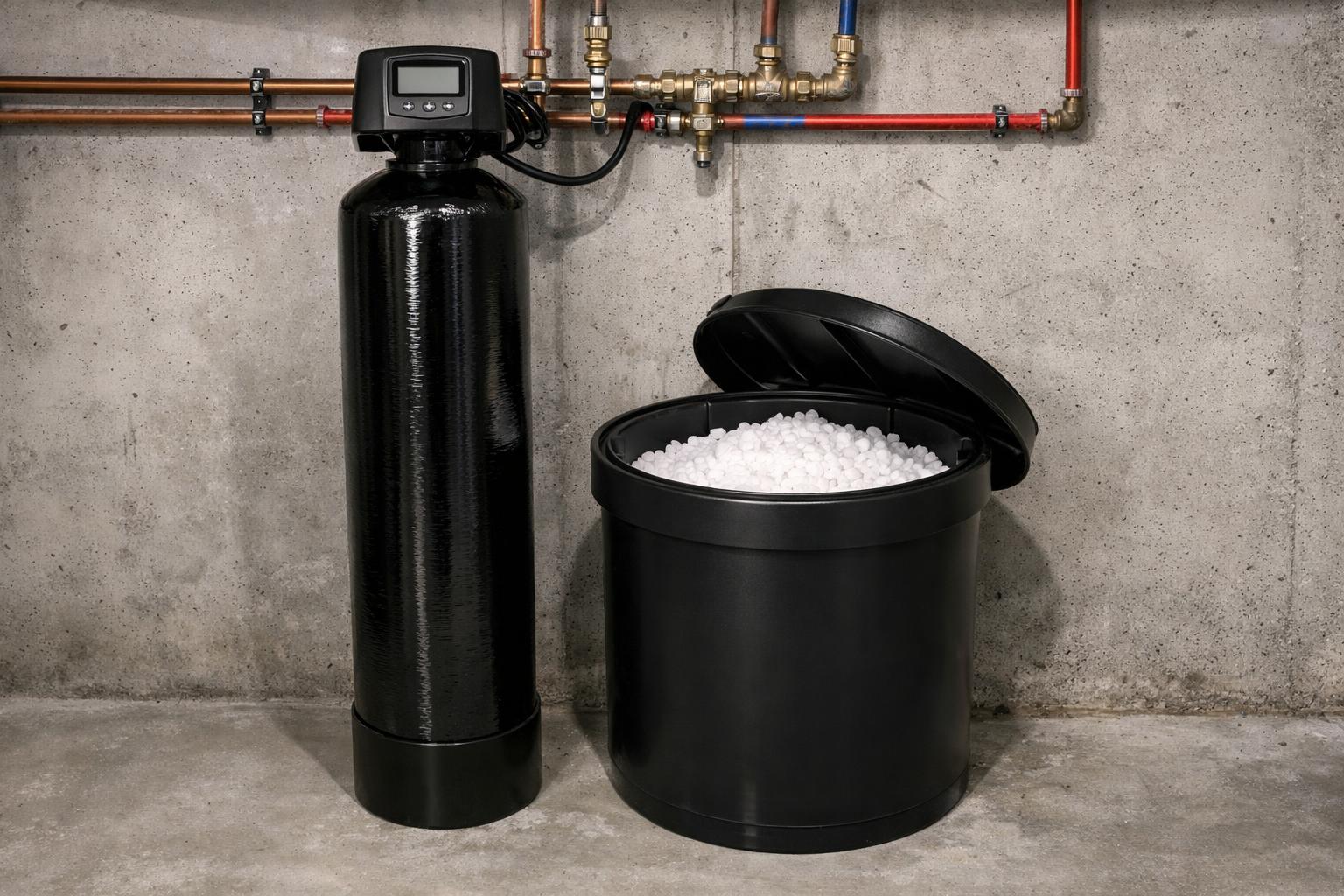
A softener is not a filter, and this is the single most expensive misunderstanding in home water treatment. No cartridge on this site removes hardness. If your kettle furs up, your glasses come out spotted and soap will not lather, a filter will not fix any of it. This is the page for that problem.
Filter or softener?
A filter removes chlorine, taste, sediment and — if rated NSF 53 — lead. It does nothing about scale.
A softener removes calcium and magnesium by ion exchange. It does nothing about chlorine, taste or contaminants. Most households with hard water end up running both.
How it actually works
The tall tank is full of resin beads carrying sodium ions. Hard water passes through, the beads grab the calcium and magnesium and release sodium in exchange. That is the whole trick — the hardness is swapped, not strained out.
Eventually the resin is full. The unit then flushes itself with strong brine from the salt tank, which forces the calcium off the beads and down the drain, recharging them with sodium. That is regeneration, and it is why a softener needs a drain connection, a power outlet and a bag of salt every so often.
Sizing one properly
This is where most purchases go wrong. Softeners are rated in grains of hardness removed between regenerations. You need three numbers.
| What you need | Where to get it |
|---|---|
| Your hardness, in grains per gallon | Municipal water report, or a test strip. If it is given in mg/L, divide by 17.1 |
| People in the house | Count them |
| Daily water use per person | Around 75 gallons is the standard planning figure |
The arithmetic
People × 75 gallons × grains per gallon = grains removed per day. Multiply by 7 for a unit that regenerates about weekly.
Four people on water at 10 grains per gallon: 4 × 75 × 10 = 3,000 grains a day, so roughly 21,000 grains a week. A 32,000-grain unit suits that household comfortably. Undersize it and it regenerates constantly, wasting salt and water; oversize it badly and the resin sits stagnant between cycles.
Salt-free “softeners” are not softeners
Salt-free conditioners use template-assisted crystallisation. They do not remove calcium and magnesium — they change the crystal form so the minerals are less likely to stick to pipes and elements.
That genuinely helps with scale in a water heater. It will not stop spotting on glassware, will not make soap lather, and your hardness test will read exactly the same afterwards. If those are your complaints, a salt-free unit will disappoint you. They earn their place where a drain or power outlet is unavailable, or where you want scale protection without adding sodium.
What it costs to run
Salt is the main consumable — typically a few bags a year for an average household, at roughly $10 to $15 a bag. Budget somewhere in the region of $50 to $100 annually, more for very hard water or a large family.
Regeneration uses water, usually tens of gallons per cycle. A metered unit that regenerates on demand rather than on a timer wastes considerably less — worth the extra cost, particularly on a well and septic system.
Against that, scale shortens the life of water heaters, kettles, dishwashers and washing machines, and a scaled element burns more energy for the same heat. The payback is real but slow and largely invisible.
The sodium question
Ion exchange adds sodium to your water, in proportion to how much hardness it removes. For most people the amount is small relative to dietary sodium from food. If someone in the household is on a medically restricted sodium intake, raise it with their doctor rather than guessing, and consider potassium chloride instead of sodium chloride in the brine tank — it works the same way and costs more.
Two practical habits: leave at least one outdoor tap plumbed on the hard side, because softened water is not ideal for the garden, and if you want drinking water with the minerals and sodium both taken back out, put a reverse osmosis unit at the kitchen sink downstream of the softener. That combination is what most hard-water households eventually settle on.
Shopping on Amazon.ca
Softener stock and pricing move constantly, so these are live searches rather than fixed listings. We earn a commission if you buy through them, at no extra cost to you.
Whole-house softeners
Metered ion-exchange units. Match the grain rating to the arithmetic above before you buy.
Salt-free conditioners
Scale protection without a drain or power. Read the section above first — these do not soften.
Hardness test strips
A few dollars, and you cannot size a softener without the number. Do this before anything else.
Softener salt
Pellets or crystals. Potassium chloride is the low-sodium alternative and costs noticeably more.
Before you order
You need a drain within reach, a power outlet, and space for two tanks roughly the height of a kitchen bin. A basement or utility room is the usual spot.
Installation means cutting into the main line and fitting a bypass. If you are not confident soldering or working with PEX, price a plumber into the decision — it is a half-day job for someone who does it regularly.
If you are on a well, deal with iron and sediment before the softener. Iron fouls resin and will ruin it. See our whole house and well water page.
More on the underlying problem: hard water in Ontario · city water vs well water
Independent guidance — we are not a retailer and cannot process orders, returns or warranty claims. Costs are general estimates, not quotes. Nothing here is medical advice; sodium questions belong with your doctor. Last reviewed September 2026.