
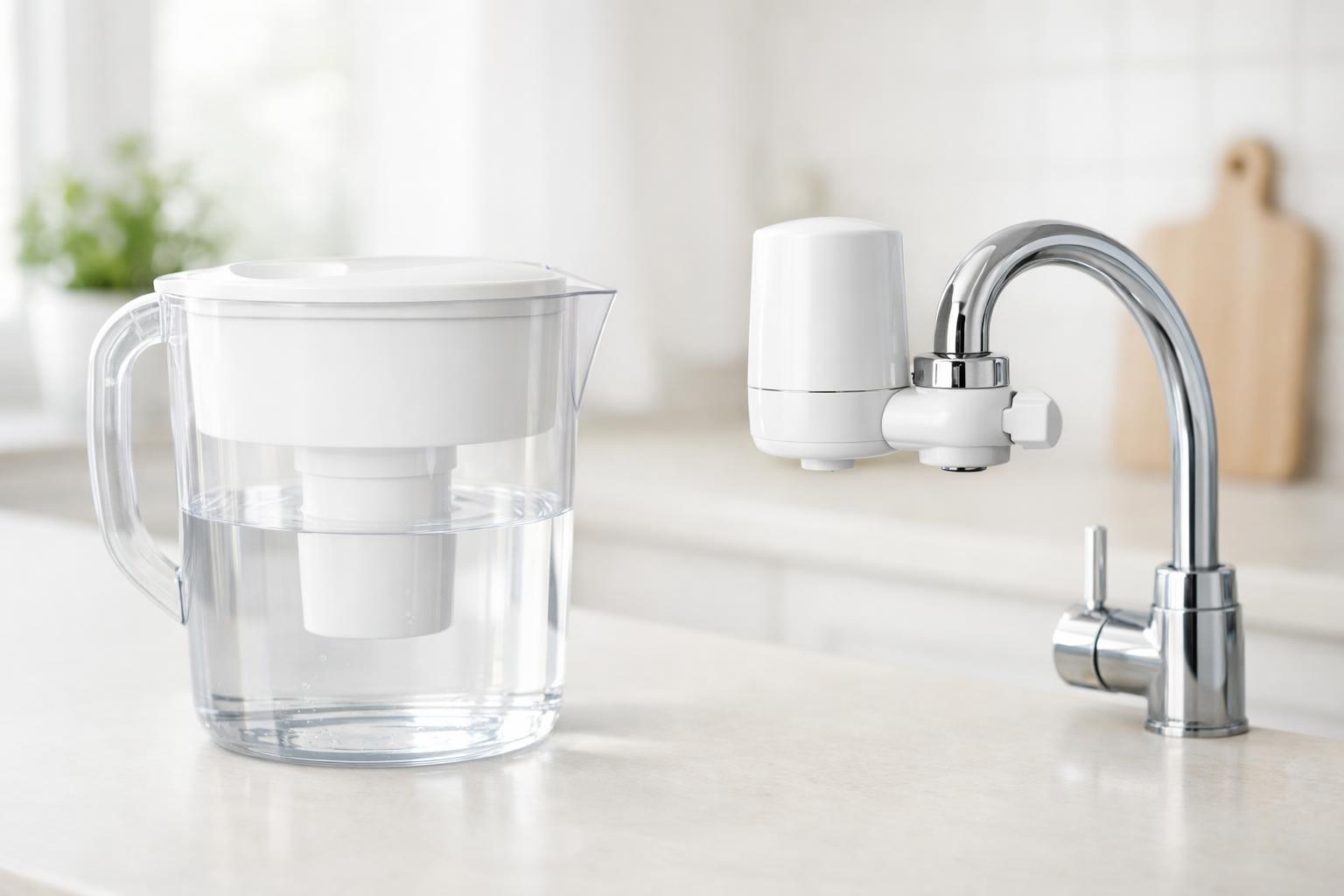
The cheapest filters to buy and the most expensive to own. A pitcher costs $20 on the shelf and then quietly costs you more per litre than any other filter in this guide. That is not a reason to avoid them — it is a reason to know the number before you commit.
The real cost per litre
Working on a household drinking and cooking with about 4 litres a day, roughly 1,460 litres a year:
| Filter type | Yearly filters | Cost per litre |
|---|---|---|
| Standard pitcher | $60–90 | 4–6¢ |
| ZeroWater (5-stage) | $180–280 | 12–19¢ |
| Faucet mount | $50–70 | 3–5¢ |
| Under-sink carbon | $50–80 | 3–5¢ |
| Bottled water | — | 40–80¢ |
Even the most expensive filter here is a fraction of bottled water. But a ZeroWater costs roughly four times what a Brita does to run, and the reason is worth understanding.
Why ZeroWater filters die so fast
ZeroWater uses ion exchange resin to strip dissolved solids, which is why it can read 000 on a TDS meter. That resin has a finite capacity, and it is consumed by all dissolved minerals — including the harmless calcium and magnesium that make water hard. In the GTA, where water is genuinely hard, a ZeroWater filter can be exhausted in two to four weeks. In a soft-water area the same filter lasts months.
So the honest answer to is ZeroWater worth it depends entirely on your local water. Hard water, expensive. Soft water, reasonable. A Brita is unaffected either way because carbon does not remove hardness at all.
Available on Amazon.ca
Prices checked August 2026. We earn a commission if you buy through these links, at no extra cost to you.
Brita 10-Cup Elite Pitcher
$38.69
The Elite filter is the lead-reducing one and lasts six months rather than two, which is what makes the running cost reasonable. Check you are buying Elite refills, not Standard — the pitchers look identical.
Brita 5-Cup Pitcher
$19.97
Chlorine taste and odour only — no lead claim. Fine for one or two people who just want tap water to stop tasting of pool. Fits in a fridge door, which the 10-cup does not.
ZeroWater 5-Stage Pitcher
$44.99
Comes with a TDS meter. Genuinely reaches near-zero dissolved solids, which nothing else on this page does. Read the section above about hard water before you commit to the refill cost.
ZeroWater Replacement Filters
$67.96
Official 5-stage refills. Buying multi-packs is the only way to make ZeroWater economical — singles are punishing.
Before you buy a faucet mount
Faucet-mounted filters will not fit a pull-out or pull-down sprayer tap, and they do not fit most European-style taps with a concealed aerator. Look at the end of your tap first: if the aerator unscrews and the spout is a plain round tube, you are fine. If the head detaches on a hose, you are not.
Getting the most out of a pitcher
Use cold water only. Hot water damages the carbon and can release what it has already captured.
Keep it in the fridge, and do not let a filled pitcher sit at room temperature for days. Filtered water has had its chlorine removed, which is precisely what was keeping bacteria down.
Change the cartridge on schedule even if the water still tastes fine. Taste is the first thing carbon stops fixing, not the last — by the time it tastes bad, it stopped working weeks ago.
When to stop using a pitcher
If you are refilling more than twice a day, an under-sink filter costs about the same to run and you never think about it again. If you need to remove nitrate, arsenic or dissolved minerals, no pitcher on the market will do it — see reverse osmosis.
Independent guidance — we are not a retailer and cannot process orders, returns or warranty claims. Cost-per-litre figures are our own estimates based on listed filter prices and manufacturer-stated cartridge life; your results will vary with local water. Last reviewed August 2026.