
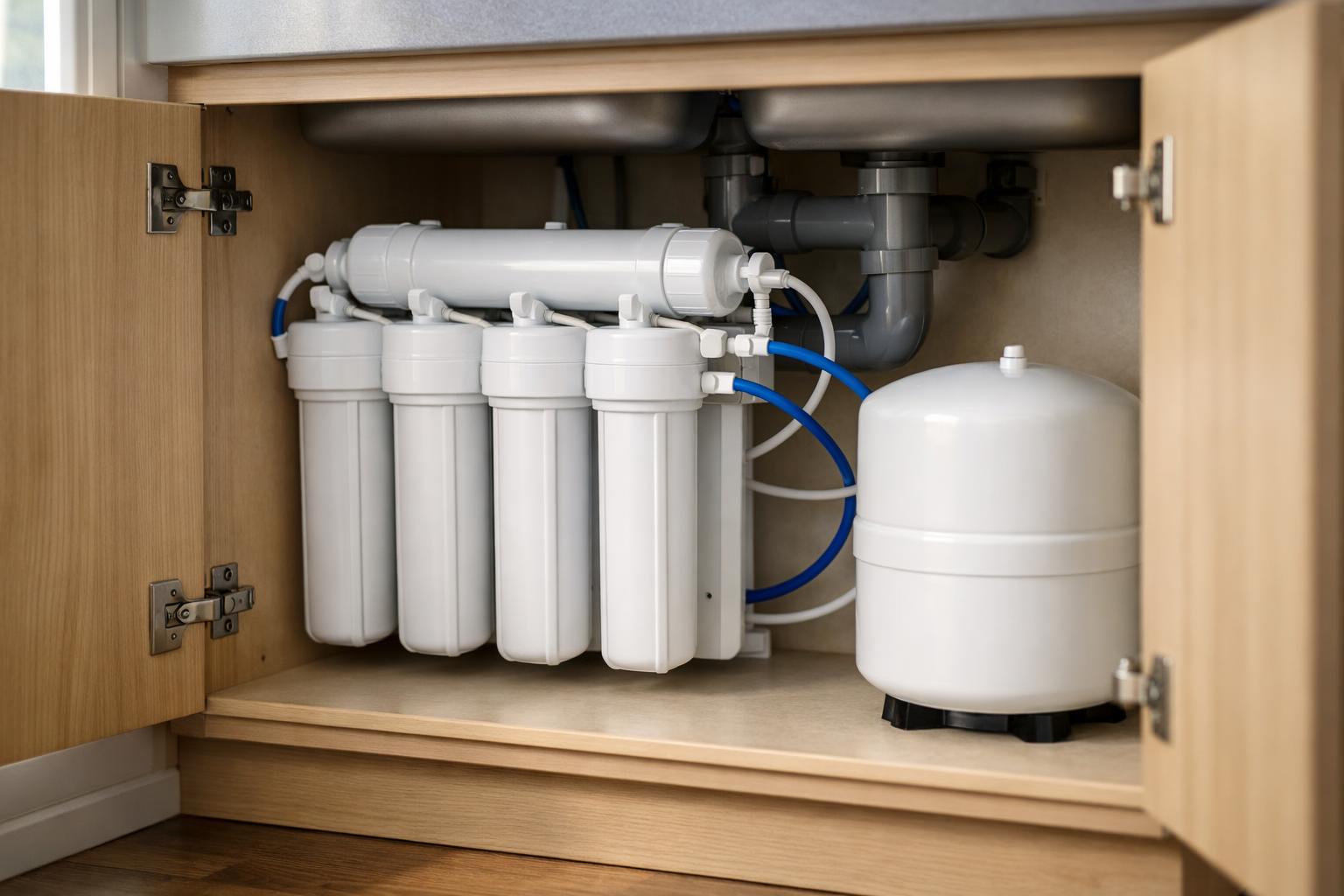
Reverse osmosis removes more than any other filter you can fit under a kitchen sink — including the contaminants carbon cannot touch. It is also the slowest, the most wasteful of water, and the most involved to install. This page explains the trade-off honestly, then lists systems that are actually in stock on Amazon.ca.
The short version
Get RO if you are on well water, your tap water is high in dissolved solids, you have tested positive for nitrate or arsenic, or you simply want the most thorough filtration available domestically.
Skip RO if your only complaint is chlorine taste. A $60 carbon filter fixes that, fits in ten minutes, and wastes no water.
What reverse osmosis actually removes
Water is forced through a membrane with pores small enough to block dissolved salts and metals, not just particles. A carbon block filter strains and adsorbs; an RO membrane rejects at the molecular level. That is why it handles things carbon alone does not.
| Contaminant | Carbon block | Reverse osmosis |
|---|---|---|
| Chlorine, taste, odour | Yes | Yes |
| Lead | Only if NSF 53 rated | Yes |
| Nitrate, arsenic, fluoride | No | Yes |
| Dissolved minerals (TDS) | No | Yes |
| Hardness (scale) | No | At the tap only — not whole house |
Three things nobody mentions before you buy
It wastes water. Older tank systems send roughly three litres to the drain for every litre they make. Newer tankless models cut that to about one to one, which matters if you are on a well and a septic field.
It is slow. A tank system refills over hours. Run the tank dry filling a stockpot and you wait.
It strips minerals too. RO water tastes flat to some people. Systems with a remineralising stage add calcium and magnesium back, which is why the alkaline models exist.
Systems available on Amazon.ca
Prices checked August 2026 and will drift. We earn a commission if you buy through these links, at no extra cost to you.
Max Water 5-Stage RO, 50 GPD
$165
A conventional tank system at the lowest sensible price. Standard 10-inch cartridges, so replacements are cheap and available anywhere. Canadian seller, which avoids the duty problem.
iSpring RCC7AK-BN, 6-Stage Alkaline
Around $300
NSF certified, 75 GPD, with a remineralising stage that puts calcium and magnesium back so the water does not taste flat. The one to pick if the flat-water complaint bothers you.
Hydrovos R1 Tankless, 600 GPD
$339
No storage tank, so no waiting and far less cabinet space used. Roughly 1:1 waste ratio instead of 3:1. NSF 372 lead-free certified. Needs a power outlet under the sink.
COMFEE Under-Sink RO, 75 GPD
$189.99
NSF certified and the cheapest certified option we found. Reviews are mixed on fitting quality — check every connection carefully for the first week.
What it costs to run
Sediment and carbon pre-filters get changed roughly every six to twelve months and cost $25 to $50 a set. The membrane lasts two to three years and costs $40 to $80. Budget $60 to $100 a year. Against bottled water at roughly $0.50 a litre, an RO system pays for itself inside a year for most households.
Before you order
Check you have room under the sink for a tank roughly the size of a basketball, plus the filter bank. Tankless models avoid this but need power.
Most kits need a hole in the sink or countertop for the dedicated tap. If you have no spare hole and a granite counter, factor in a plumber.
If you have a well, test the water first. RO handles nitrate and arsenic but a heavy iron or sediment load will destroy the membrane unless you pre-filter it. See our whole-house and well water page.
Independent guidance — we are not a retailer and cannot process orders, returns or warranty claims. Last reviewed August 2026.