
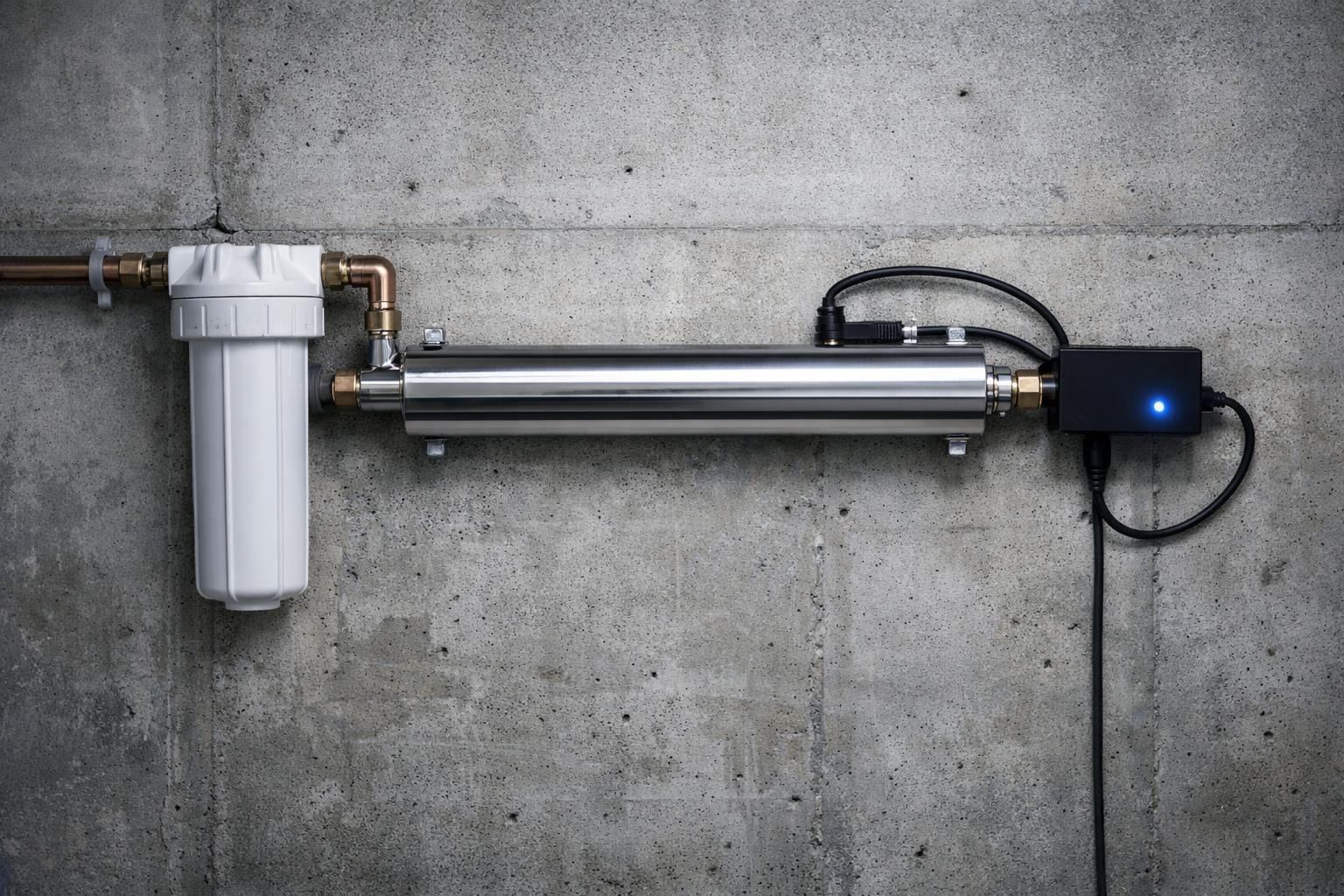
Every other page on this site is about removing things from water. This one is not. Ultraviolet disinfection removes nothing at all — it inactivates living organisms and leaves the water chemically identical. That distinction is the whole subject, and getting it wrong is how people end up trusting equipment that is not protecting them.
UV is not a fix for a contaminated well
If a test has come back positive for E. coli or total coliforms, that is a signal that something is getting into your well — a failed seal, a cracked casing, surface water finding a path in, or a septic system too close. Bolting a UV lamp onto the plumbing treats the symptom and leaves the cause running.
Boil your water, get the well shock-chlorinated and physically inspected, then retest. UV belongs afterwards, as ongoing insurance on a well that has been put right — not as a substitute for fixing it.
How it works
Water passes through a stainless steel chamber around a quartz sleeve containing a UV-C lamp. The light damages the DNA of bacteria, viruses and protozoa so they cannot reproduce. They are still physically in the water; they simply cannot make you ill.
Nothing is filtered out. Hardness, iron, nitrate, lead, chlorine and dissolved solids all pass through completely unchanged. Your TDS reading before and after a UV unit is identical. It is a disinfection step, not a treatment step, and it does one job extremely well.
Class A or Class B — this matters more than the price
NSF/ANSI 55 Class A systems are validated to disinfect water that may contain harmful organisms. This is the standard you want on a private well. They deliver a higher UV dose and include a sensor that warns you when output drops.
Class B systems are supplemental only, intended for water that is already considered safe. They are cheaper, and they are the wrong purchase for a well with a bacterial history. Check which class a unit is certified to before comparing anything else.
UV needs clear water to work
This is the failure mode nobody mentions at the point of sale. UV works by light reaching the organism. Anything that blocks or scatters that light protects the bacteria from the lamp.
Sediment casts shadows. Organisms hiding behind a particle pass through alive. A 5-micron sediment pre-filter ahead of the unit is not optional.
Iron and manganese coat the quartz sleeve, dimming it steadily until almost no light reaches the water. If your well stains fixtures orange, deal with the iron first.
Hardness scales the sleeve for the same reason it furs a kettle. Very hard water shortens the interval between sleeve cleanings considerably.
The correct order of treatment
Well pump → sediment filter → iron or manganese treatment if needed → softener if needed → UV last → house. UV always sits at the end, immediately before the water is used, because anything downstream of it can recontaminate.
Sizing and running it
Units are rated by flow in gallons per minute at a given UV dose. Size to your peak demand, not your average — a shower plus a running tap plus a washing machine at once. Push more water through than the unit is rated for and contact time falls below what is needed to inactivate anything.
It runs constantly and needs power. A power cut means untreated water, immediately. After any outage, run the taps for a minute once the lamp is back on and warmed up.
The lamp is replaced annually, whether or not it still glows. UV-C output falls off long before the visible light does. A lamp that looks fine can be well below the dose needed. This is the maintenance item people skip, and skipping it silently removes your protection.
The quartz sleeve gets wiped clean at the same time. Budget roughly $60 to $120 a year for a lamp, plus sediment cartridges, plus a few dollars of electricity — it draws about as much as a light bulb.
Shopping on Amazon.ca
These are live searches rather than fixed listings, because UV stock changes often. Confirm the NSF 55 class and the flow rating on any listing before buying. We earn a commission if you buy through them, at no extra cost to you.
UV disinfection systems
Whole-house units. Match the GPM rating to your peak demand and look for NSF 55 Class A.
Replacement lamps & sleeves
Annual consumable. Order by your unit’s model number, and buy the spare before you need it.
Sediment pre-filters
5 micron, fitted upstream. Without this your UV unit is not doing what you think it is.
Bacteria test kits
Useful between lab tests — but Ontario offers free bacterial testing, so use that as your primary check.
Free testing in Ontario
Public Health Ontario provides free bacterial testing for private wells. Collection bottles come from your local public health unit. Test at least three times a year, and always after spring melt or heavy rain. A UV system does not remove the need to test — it is how you find out whether the system is still working.
Related
Whole house and well water filters — the sediment and iron stages that go ahead of UV.
Water softeners — if hardness is scaling your quartz sleeve.
Reverse osmosis — for nitrate and arsenic, which UV does nothing about.
Independent guidance — we are not a retailer and cannot process orders, returns or warranty claims. Nothing here replaces a laboratory water test, a licensed well contractor, or advice from your local public health unit. If your water may be unsafe, follow their guidance rather than ours. Last reviewed September 2026.