
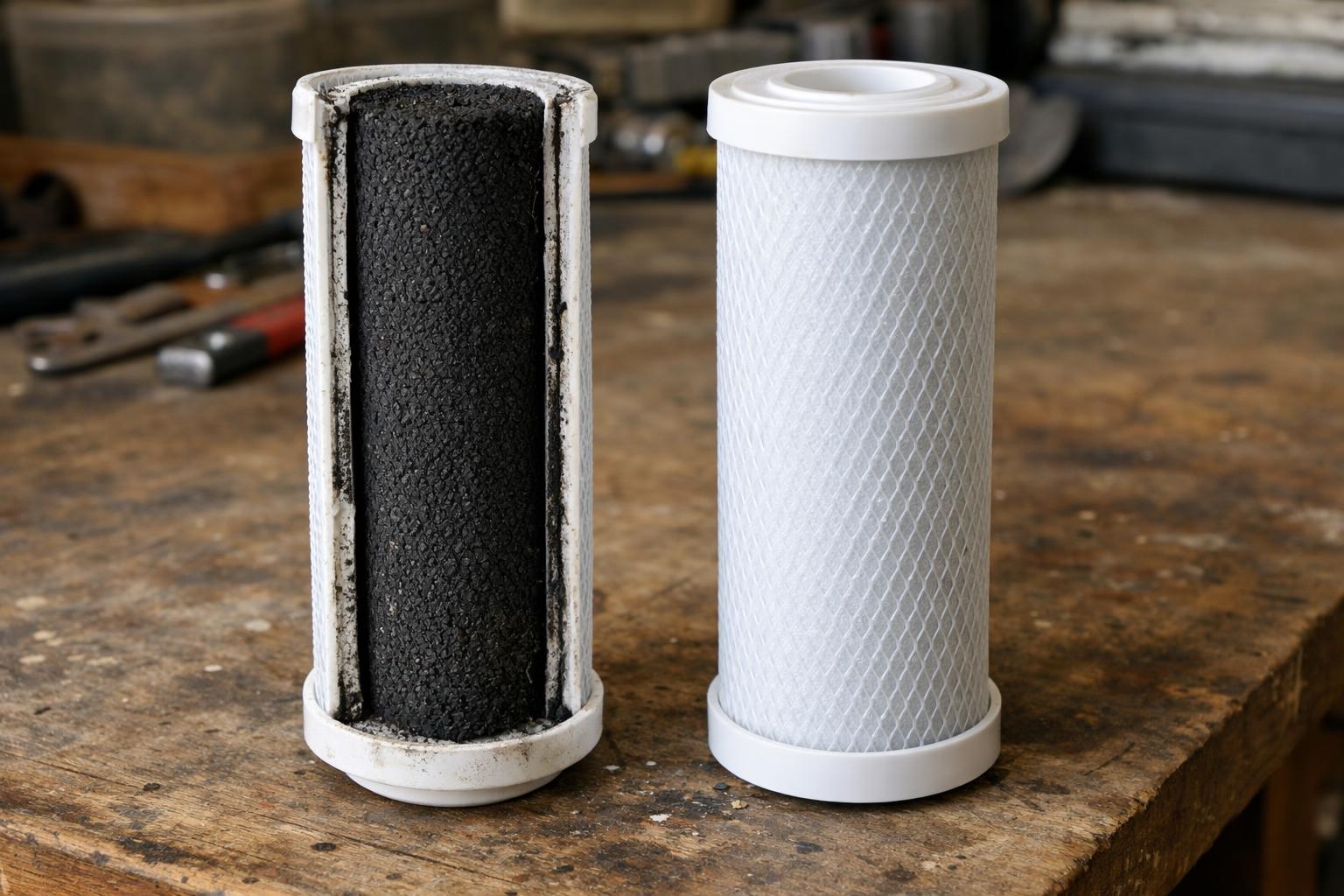
Almost everyone runs their filter too long. Not out of carelessness — because the signal people wait for is the wrong one. Taste is the first thing a carbon filter stops fixing, not the last. By the time the water tastes off again, the filter stopped doing its real job weeks earlier.
What is actually happening inside
Activated carbon works by adsorption: contaminants stick to an enormous internal surface area. That surface is finite. Once it is occupied, the filter is a tube that water flows through.
Worse, a saturated carbon filter left in service can begin releasing some of what it captured back into the water — a phenomenon called dumping. And because the chlorine has been stripped out, a wet, warm, exhausted cartridge is a reasonable place for bacteria to grow. An old filter is not neutral. It can be worse than no filter.
Intervals by filter type
| Filter | Change every | Change sooner if |
|---|---|---|
| Pitcher (standard) | 2 months / 150 L | Flow slows noticeably |
| Pitcher (lead-rated) | 6 months / 450 L | Never run past date if lead is why you bought it |
| ZeroWater / ion exchange | When TDS reads 006+ | Hard water — can be 2–4 weeks in the GTA |
| Faucet mount | 3 months / 380 L | Pressure drops |
| Refrigerator cartridge | 6 months / 750 L | Ice tastes odd, dispenser slows |
| Under-sink carbon | 6–12 months | Sediment-heavy supply |
| RO pre-filters | 6–12 months | Neglecting these destroys the membrane |
| RO membrane | 2–3 years | Output TDS climbing |
| Whole-house sediment | 3–6 months | Spring melt on a well |
The fridge indicator light is a timer
It counts down from when you last reset it — or in some models, counts litres dispensed. It has no sensor and knows nothing about your water quality. If you are on hard or sediment-heavy water, your filter is finished before the light says so. If you use very little water, the light will nag you early. Use it as a reminder, not a verdict.
What it costs to run, per litre
Based on a household using about 4 litres a day for drinking and cooking — roughly 1,460 litres a year. Filter prices are Canadian, August 2026.
| Method | Upfront | Per year | Per litre |
|---|---|---|---|
| Faucet mount | $35 | $50–70 | 3–5¢ |
| Under-sink carbon | $120–250 | $50–80 | 3–5¢ |
| Pitcher | $20–40 | $60–90 | 4–6¢ |
| Reverse osmosis | $165–340 | $60–100 | 4–7¢ |
| Fridge cartridge | — | $60–120 | 4–8¢ |
| ZeroWater, hard water | $45 | $180–280 | 12–19¢ |
| Bottled water | — | $580–1,170 | 40–80¢ |
These are our own estimates from listed cartridge prices and manufacturer-stated capacities. Your figures will differ with local water and how much you actually drink.
Four ways people waste money on filters
Running them too long. The single biggest one. A $20 cartridge stretched to a year is not a saving, it is an unfiltered tap you are paying for.
Buying certification you do not need. If your water has no lead problem, an NSF 53 lead-rated filter costs more and does nothing extra for you.
Buying certification you do need and not checking. The opposite error. “Reduces 30+ contaminants” on the box is marketing. The certification line on the back is the claim that means something.
Ignoring RO pre-filters. A $30 sediment cartridge protects a $70 membrane. Skip the cheap one and you replace the expensive one.
A system that actually works
Write the date on the cartridge in marker when you fit it. Not the date it is due — the date you fitted it. Due dates get recalculated optimistically.
Set a recurring calendar reminder for the interval, and buy replacements in multi-packs so there is always one in the cupboard. The main reason people run filters long is that ordering one takes a week.
Flush 3–4 litres through any new cartridge before drinking. The black flecks are loose carbon — harmless, but they taste bad and clog ice makers.
Related
Identify your water filter — if you are not sure what you have.
Pitchers and faucet mounts — cheapest to buy, dearest to run.
Fridge filters by part number — Whirlpool, GE, Frigidaire and Bosch.
Cost figures are estimates for comparison, not quotes. Last reviewed August 2026.